
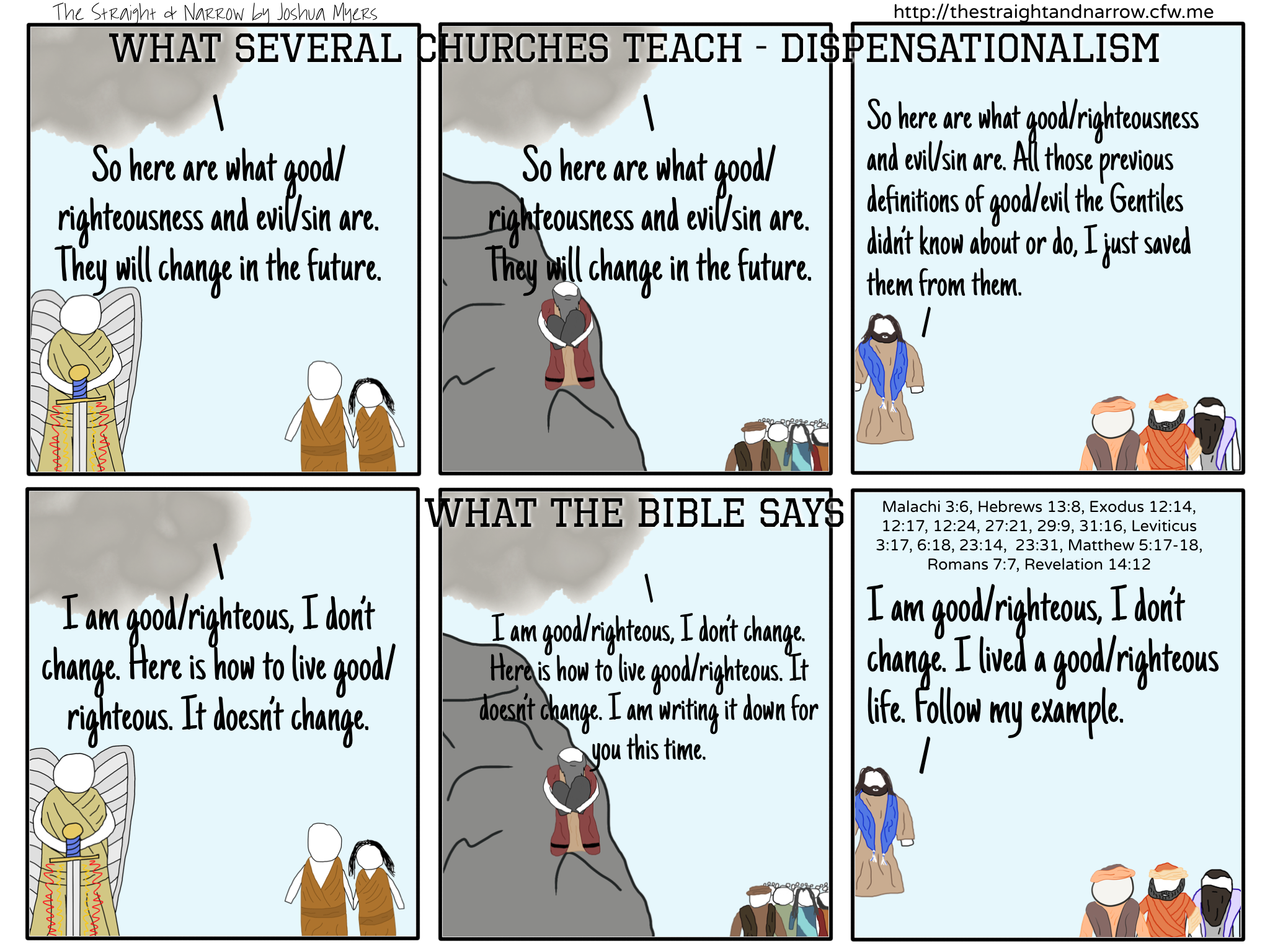
I believe this one speaks for itself, especially when you go back to the Scripture I have listed and all of them talk about everything being forever. Forever doesn’t end. You see, there is no where in the prophets that tell us that God did or will ever split His instructions into different time periods and the instructions would be different in those periods. The thing usually used to support this thought is Jeremiah 31, specifically verse 32, out of context.
There several problems with using Jeremiah 31 to support Dispensationalism:
1) Verse 31 specifically states He is making this new covenant with only the House of Israel and the House of Judah. To understand what this means about the House of Israel and House of Judah, you have to go back to King Solomon and his sons and the split of Israel. Neither of these groups are Gentiles.
2) Verse 34 states that no longer will anyone have to tell his brother “Know the LORD”, because everyone will know Him. This verse alone and the world around us shows that this covenant is not in effect yet. If it was, why missionaries? Why atheists? Why anyone following any other religion? Because the world does not know Him as Jeremiah is telling us it will. This isn’t something that can be spiritualized to say “well we all know deep down there is a God”, Psalm 14:1.
3) The first part of Jeremiah is talking about bringing the Houses back to the Land after what sounds like a battle. To me, it sounds like after the Tribulation. It also talks of people going to Zion to the LORD. I don’t know of anyone that believes we are in the New Covenant that believes the LORD is in Zion right now or that we have to go there to see Him.
4) I left verses 32 and 33 last on purpose. To understand these verses you have to keep in mind a couple of other verses: Ecclesiastes 1:9 (there is nothing new under the sun) and Isaiah 46:10 (I have made known the end from the beginning). These actions aren’t something new God is doing, He has done it before. First, we sinned and God verbally told us how to live (Genesis). When we didn’t listen, He had them written down (Exodus-Deuteronomy) and we were told to put these laws on our hearts (Deuteronomy 11:18). A new beginning was given through Jesus, who lived out a life that follows God’s way of living and told us to follow Him. We didn’t listen, instead have all these theologies that state we don’t have to keep God’s commands. So we get to verse 32 and 33, where He will write them on our hearts, not us this time. To me, in a way a removal of free-will. I don’t think it is a removal of it, but think about it this way: We all have a built in sense of self preservation. If something is going to kill or harm us, we are more apt to not do it, right? However, we have people that still will go through with things, including suicide. They had to fight that self-preservation. I see verse 32 and 33 as building into us His Laws, so that they become natural, a habit. We would have to fight to NOT do them. Which of course, is not happening today.
The scary part of Dispensationalism is that at any moment, God could change His mind. In the OT, drinking strong drink was encouraged, especially during the Feasts, but there are churches today that teach it is a sin to drink at all. Eating pork was a sin listed in the OT, but churches today hold BBQs with pork as a central part of the meal. What if tomorrow He reverses it again? Where would everyone be in their relationship with Him? These two things listed are simple things. What about weighter matters? He could send someone else as Salvation to us and call Jesus’ ways death (as some churches teach Moses’ ways are death). There are so many logical conclusions that can be made if you subscribe to Dispensationalism. We can see one of them running rampant in the churches today and that is Hyper-grace. I know many denounce this teaching, but it is spreading and spreading wildly. Why? Because it is a logical conclusion if you truly believe that God’s commandments, the Law of Moses, the Law of God, is no longer for us.
0 Comments