
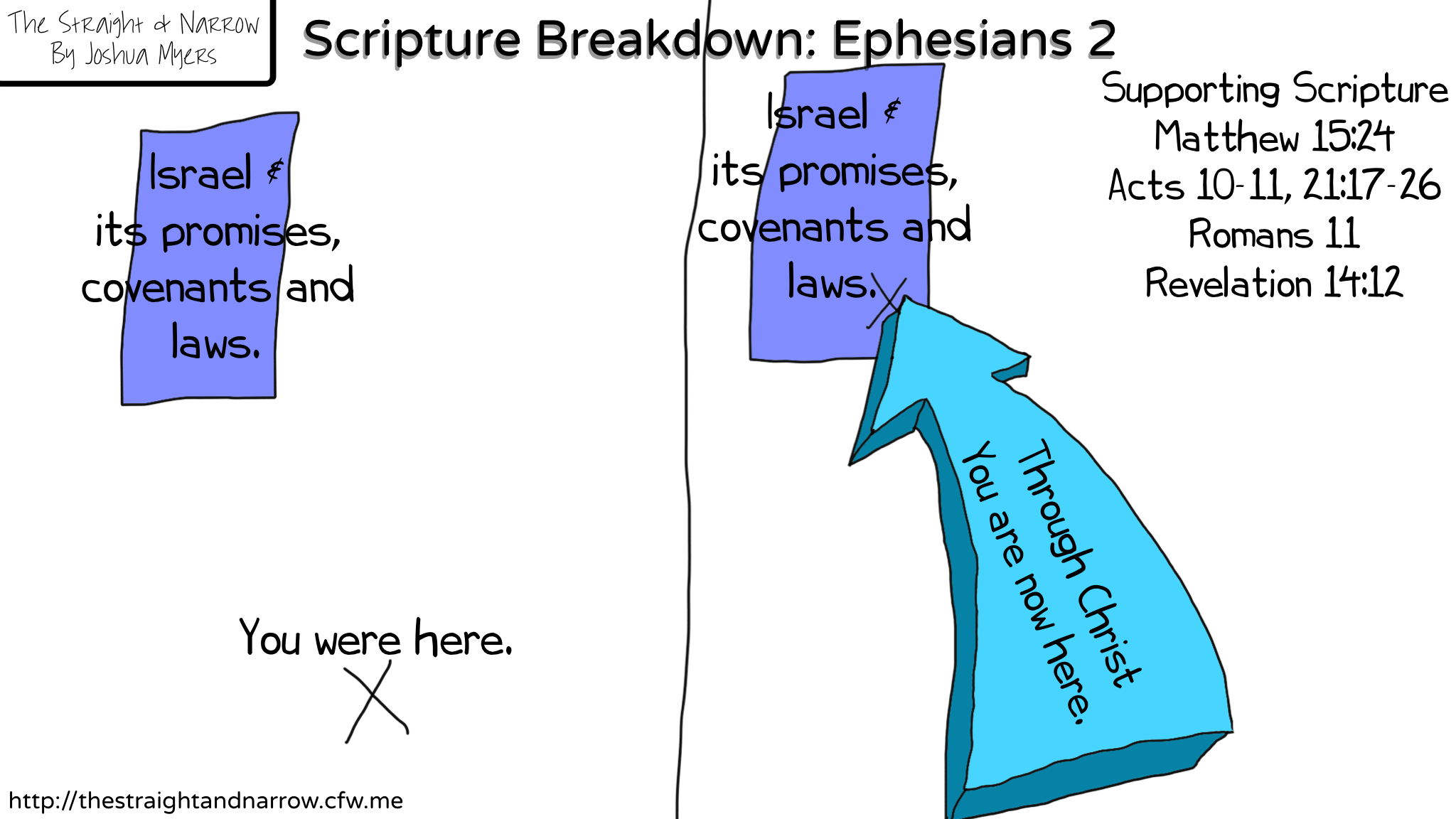
I believe this and the supporting Scripture is often misunderstood, and it is so because as Peter says in 2 Peter 3:16, Paul is hard to understand. If we read this chapter in the context of the rest of the Bible, we can see that those who follow God are Israel, thus Paul is just explaining that through Christ, we can now be part of Israel.
Another note I wanted to add to this as it came up in my pulling of supporting Scripture: Romans 10:5-8.
5 For Moses writes about the righteousness that is based on the law, that the person who does the commandments shall live by them. 6 But the righteousness based on faith says, “Do not say in your heart, ‘Who will ascend into heaven?’” (that is, to bring Christ down) 7 “or ‘Who will descend into the abyss?’” (that is, to bring Christ up from the dead). 8 But what does it say? “The word is near you, in your mouth and in your heart” (that is, the word of faith that we proclaim); [ESV]
Two things to point out. First, the “But” there in verse 6 doesn’t only mean “but” in Greek, it could also be “and”. Why is this important? Because in English we see “but” and “and” as kind of opposites. “But” is usually changing the subject or countering what was said, while “and” is including. I believe in this case, the better translation would be “and”, because …
Secondly, the things the righteousness based on faith says, are in the Law of Moses. Deuteronomy 30:11-16 – Paul is quoting this to not only show that the Law is righteousness, but that He is equating it to Christ (just like John 1 does: In the beginning was the Word….). He is God’s Word made Flesh, what is God’s Word? The Torah/The Law.
0 Comments